
The Power of Breath: Daoist Taixi and Modern Stress Management
9/14/20253 min read
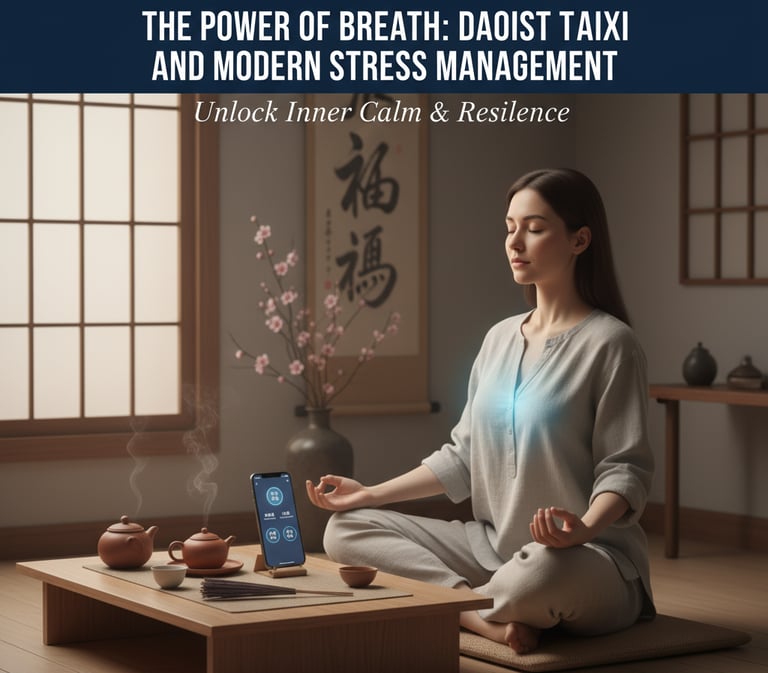
Workplace "Invisible Suffocation": The Imbalance of Stress and Breath
In the relentless pace of today’s professional world, feeling "stressed out" has become the norm. When facing looming deadlines, complex decisions, or urgent tasks, our bodies instinctively trigger the "fight-or-flight" response. The first sign of this physiological alarm is a shift to rapid, shallow, non-functional chest breathing. Remaining in this state of "invisible suffocation" for too long not only leads to physical symptoms such as tense shoulders and chest tightness, but also drastically diminishes our psychological resilience to cope with pressure.
If you typically rely on sheer willpower (a "top-down" approach) to fight anxiety, it’s time to explore a more direct and highly effective "bottom-up" intervention: breathing training. Experts hail it as the fastest way to trigger a state of deep rest. The pinnacle of this ancient technique was outlined in Daoist wisdom: Embryonic Breathing (Taixi).
Science Decoded: From Taixi to Resonant Breathing
Taixi is not mystical; it represents an optimal method for regulating the human autonomic nervous system (ANS). The Daoist pursuit of "deep, long, fine, and even" breathing—mimicking the minimal breath of a fetus—aims to achieve "Qi sinking to the Dantian" (the lower abdomen) by fully engaging the diaphragm for abdominal breathing.
In modern physiology, this ideal state has a precise scientific term: Resonant Breathing. This state is achieved when breathing slows to six breaths per minute or fewer. At this frequency, the cardiovascular system works in peak synchrony, sending an immediate "all-clear" signal to the brain.
Its core professional value lies in two areas:
Reshaping Neural Flexibility: Resonant Breathing significantly elevates heart rate variability (HRV). A high HRV indicates a resilient ANS, capable of swiftly shifting from a tense sympathetic state back to a relaxed parasympathetic state, effectively regulating emotions.
Optimizing Biochemistry: Quality breathing requires a "Light, Slow, Deep" approach. Hyperventilation (rapid, heavy breathing) expels too much carbon dioxide (CO₂), causing vasoconstriction and paradoxically reducing the body’s ability to utilize oxygen. In contrast, slow, light, deep breathing increases CO₂ tolerance, ensuring efficient oxygen delivery and promoting emotional stability.
A Practical Guide: Instant Mind-Body Harmony at Your Desk
The strength of breathing training lies in its accessibility, allowing for self-healing right at your workstation.
1. Foundational Training: Light, Slow, Deep (LSD) Diaphragmatic Breathing
This is the gold standard for returning to the Taixi state. Practicing for 10 to 20 minutes daily can fundamentally reset your stress arousal level.
Posture: Sit upright, chest open, and chin slightly tucked to keep the airway clear.
Path: Keep your mouth closed and breathe exclusively through your nose.
Action: Apply the "Light, Slow, Deep" method: inhale gently, allowing your abdomen to rise slowly; then exhale slowly and evenly. Focus on the ribs expanding outward, not dramatic chest lifting.
2. Quick Countermeasure: The 4/7 Stress Reset
When acute anxiety strikes or before a high-stakes meeting, you need to break the panic cycle quickly.
Technique: Inhale for 4 seconds, exhale for 7 seconds.
Key Point: Extending the exhalation stimulates the vagus nerve, quickly engaging the parasympathetic nervous system. This calms the body within minutes, preparing you to handle immediate pressure.
3. Intentional Focus: Emotional Self-Healing
Combine visualization with meditation to make breathing an emotional detox.
Method: Close your eyes and focus on the tip of your nose, noticing the air moving in and out. As you inhale, imagine drawing positive energy, light, and warmth into every cell of your body. As you exhale, release negative emotions, worries, and irritation.
Conclusion: Free and Effective Self-Healing
The power of breath lies in its ability to address the physical symptoms triggered by stress directly. For example, a high-pressure professional reported a significant reduction in stress-related discomforts such as shoulder soreness and chest tightness after consistently practicing breathing relaxation therapy.
The Daoist pursuit of ultimate breath control has now been validated by modern science. This is a zero-cost, highly effective, non-pharmacological intervention.
Start incorporating this ancient wisdom into your professional life today. Remember the core philosophy: "Practice without doubt, without interruption, and with perseverance."
Your breath is your most powerful tool for stress reduction.
In harmony with the Dao, in balance with life.
© 2025 Dao Culture Center. All rights reserved.
All content and materials are for educational purposes only.


Wisdom · Energy · Harmony · Awakening
Explore the Dao
FAQs
Follow the Flow
Harmony is not found — it is practiced.
|
|