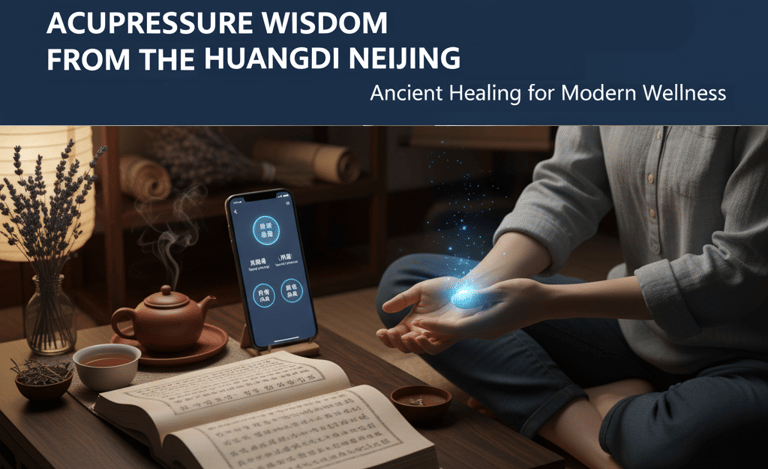
Acupressure Wisdom from the Huangdi Neijing: Ancient Healing for Modern Wellness
9/28/20252 min read
Ancient Roots of Wellness
Over 2,000 years ago, Chinese scholars compiled the Huangdi Neijing (The Yellow Emperor’s Inner Canon). Often called the “medical encyclopedia of the East,” this Daoist classic became the foundation of Traditional Chinese Medicine (TCM). Its timeless lesson is clear: health is more than the absence of illness—it is balance, harmony, and flow.
From Superstition to Prevention
In a world where people once blamed spirits for disease, the Huangdi Neijing introduced a new way of thinking. It explained how diet, emotions, environment, and aging could disrupt the body’s balance.
The message was empowering: you are not a victim of fate—you are responsible for your well-being.
This philosophy, known as yang sheng (nurturing life), encourages prevention, seasonal living, and emotional balance. It’s a principle that resonates strongly with modern preventive medicine.
Yin, Yang, Qi, and Blood
The Daoist view sees the body as a small universe:
- Yin: stillness, coolness, nourishment
- Yang: warmth, activity, movement
- Qi: vital energy, circulating like a current
- Blood: nourishment and grounding
When yin and yang are balanced and qi and blood flow freely, health thrives. Imbalance, however, leads to discomfort and disease.
Meridians and Acupoints: The Body’s Energy Network
The Huangdi Neijing describes meridians—energy pathways connecting organs and tissues. Along them lie acupoints, gateways that influence the flow of qi and blood.
Modern research suggests these points often correspond to nerve clusters or connective tissue intersections. Stimulating them through acupressure can reduce stress hormones, improve circulation, and activate the body’s natural healing response.
Five Essential Acupoints for Everyday Health
Acupressure is a simple, effective way to bring ancient wisdom into daily life. Try pressing these points for 1–3 minutes:
- Shenmen (HT7 – “Spirit Gate”): calms the mind, improves sleep, reduces anxiety
- Neiguan (PC6 – “Inner Pass”): eases stress, nausea, and motion sickness
- Hegu (LI4 – “Joining Valley”): relieves headaches, sinus issues, and muscle tension
- Zusanli (ST36 – “Leg Three Miles”): boosts energy, digestion, and immunity
- Taichong (LR3 – “Great Surge”): releases emotional tension, balances mood
Enhance Results with Breath and Meditation
Pairing acupressure with deep breathing or meditation amplifies its benefits. Slow, mindful breathing while pressing a point creates a body–mind feedback loop that melts away stress and restores calm.
Living the Wisdom of the Huangdi Neijing
This ancient text is more than history—it’s a practical life guide:
- Live with nature’s rhythm: adjust your lifestyle to the seasons
- Practice prevention: correct small imbalances before they become illness
- Balance yin and yang: pair work with rest, thought with stillness
Acupressure is not just a healing method—it’s a daily ritual of self-connection. In today’s fast-paced world, the Huangdi Neijing reminds us to slow down, tune inward, and rediscover balance and vitality.
Friendly reminder: If you’d like to read the Huangdi Neijing for free, you can find it in our e-library.
In harmony with the Dao, in balance with life.
© 2025 Dao Culture Center. All rights reserved.
All content and materials are for educational purposes only.


Wisdom · Energy · Harmony · Awakening
Explore the Dao
FAQs
Follow the Flow
Harmony is not found — it is practiced.
|
|